
Corn rootworms, armyworms, and borers don’t negotiate — they destroy. So if you’ve put serious money into your corn crop, pest control needs a solid plan, not guesswork.
Chlorantraniliprole ranks among the most powerful insecticides available to farmers today. But results depend on how you use it. Miss the application window, fall short on coverage, or overlook resistance pressure — your input costs go to waste.

Application Methods
Getting chlorantraniliprole into your corn field is simple. Getting it to work — that’s where the details matter.
Farmers use three main delivery methods. Each one serves a different purpose based on your crop stage, pest pressure, and equipment setup.
Seed Treatment
This is the most practical starting point for chlorantraniliprole. The active ingredient coats the seed before planting. Protection starts the moment germination begins.
The coating moves the compound into the root zone as the plant grows. No separate spray pass needed. No timing guesswork. The protection is built in from day one.
Seed treatment rates run lower than foliar or soil applications. Don’t assume more is better. Exceeding label rates won’t boost performance — it just adds resistance pressure you don’t need.
Soil Application (In-Furrow or Banded)
In-furrow application places chlorantraniliprole into the seed zone at planting. Banded application puts it in a concentrated strip along the row.
Both methods work well against:
-
Corn rootworm (the number one yield-robbing pest in North American corn production)
-
Black cutworm larvae active near the soil surface
-
Early wireworm feeding
Make sure your liquid injection system is calibrated before you start. Uneven distribution creates uneven protection — some plants get full coverage while others get almost none.
Granular formulations are available for soil banding too. These are a solid choice if your planter already handles granule delivery. You skip the hassle of adding liquid handling equipment entirely.
Foliar Spray Application
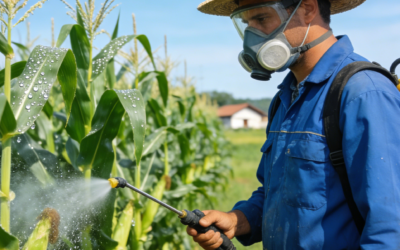
Foliar application targets above-ground pests during active growing stages. That includes fall armyworm, western bean cutworm, and European corn borer — all capable of wiping out an otherwise healthy canopy.
Aerial application makes sense in large-scale operations where ground equipment would damage the crop. Drone application is picking up ground for precision targeting in high-value fields.
No matter which method you use, calibrate your equipment before the season starts. A 10% application error doesn’t just cost you money — it puts your entire protection window at risk.
Application Timing and Rates

Getting the timing wrong on a chlorantraniliprole application is one of the costliest mistakes a corn farmer can make. The product itself isn’t the problem. The pest simply wins before the chemistry has a chance to work.
Here’s the reality: chlorantraniliprole doesn’t rescue a damaged crop. It protects a healthy one. That difference shapes your entire application schedule.
Hitting the Right Window
Your timing depends on two things — which pest you’re targeting and which delivery method you’re using.
For soil and in-furrow applications at planting:
-
Apply at planting for corn rootworm and early-season soil pests
-
Hit the window before larvae reach the second instar stage. Once they start feeding on roots, the below-ground damage is done
-
In most corn-producing regions, this lines up with soil temperatures hitting 50°F at 4-inch depth
For foliar applications targeting above-ground pests:
-
Fall armyworm: Apply at first larval detection, around V4–V8 growth stage
-
European corn borer: Time your spray to egg hatch, just before first-instar larvae bore into the stalk — around tassel emergence (VT stage)
-
Western bean cutworm: Target the pre-egg hatch period, tracked through pheromone traps
Miss these windows by even a few days and you’re spraying larvae that have already burrowed out of reach. Surface coverage won’t touch them.
Rate Recommendations That Deliver Results
Chlorantraniliprole rates shift based on formulation, application method, and target pest. Staying within label ranges isn’t just a legal requirement. It’s also a resistance management strategy.
Seed treatment rates:
– Range from 0.25 to 1.25 mg a.i. per seed, based on the product and pest pressure level
– Higher rates make sense in fields with confirmed rootworm pressure or a history of below-ground feeding damage
Soil/in-furrow application rates:
– General range: 0.017 to 0.067 lb a.i. per acre
– Match the rate to your actual pest pressure. Medium-pressure fields don’t need the maximum rate
Foliar application rates:
– Typical range: 0.047 to 0.098 lb a.i. per acre
– For heavy armyworm or borer pressure, move toward the higher end of the label range
– Do not exceed the seasonal maximum. Stacking multiple applications without tracking the cumulative rate puts extra selection pressure on local pest populations — and that builds resistance faster
One Rule That Never Changes
No matter the timing, pest, or formulation — read the current product label before every application. Rates get updated. Registrations change. What was accurate two seasons ago may not hold today.
Keep a simple log of your application dates, rates, and field conditions. Mid-season performance gaps are much easier to sort out with real data in hand. You’ll know what went in, when it went in, and where the protection window started and ended — no guesswork needed.
That’s how a chemical input becomes a real agronomic advantage.
Spray Coverage Requirements
Coverage isn’t just a checkbox — it’s the difference between chlorantraniliprole doing its job and your investment evaporating into thin air.
The chemistry is only as effective as the physical reach of your application. Even a perfectly timed foliar spray falls apart if the product never makes contact with your target pest population. That’s the part most farmers underestimate.
Water Volume Is Non-Negotiable
Minimum water volume for corn foliar applications sits at 15–20 gallons per acre. That’s not a suggestion — it’s the floor.
Drop below that water volume and you get patchy coverage. Patchy coverage means surviving larvae. Surviving larvae mean resistance selection pressure — and you’ve paid full price for a half result.
Nozzle Selection and Droplet Size
Flat-fan nozzles remain the standard for chlorantraniliprole foliar applications. Medium droplet size (250–350 microns) balances two competing needs: drift reduction and canopy penetration.
Go too fine and drift carries product off-target. Go too coarse and droplets bounce off leaf surfaces without sticking.
Adjuvant Use
A quality non-ionic surfactant or methylated seed oil adjuvant improves coverage by reducing surface tension on the leaf. This matters especially on corn, where the waxy cuticle repels water-based sprays.
Rainfastness is a real concern too. Chlorantraniliprole needs at least 1–4 hours of dry time after application before rainfall — adjuvants help lock coverage in place during that window.
Don’t treat adjuvant selection as an afterthought. It directly affects how much active ingredient stays on the plant surface where pests feed.
Resistance Management

Resistance doesn’t build overnight — but by the time you notice it, you’re already behind.
Chlorantraniliprole belongs to IRAC Group 28, the diamide class. That’s a single mode of action. Rely on it season after season, and local pest populations gain a selection advantage. Survivors pass on tolerance traits to the next generation. A few generations later, your most reliable insecticide stops working.
That’s not a theoretical risk. It’s happening in fields right now.
Why Mode of Action Rotation Is the Baseline Strategy
Rotating chemical classes is the most important resistance management step you can take. Don’t just rotate products — rotate modes of action.
Here’s what that looks like in practice:
-
Year 1: Chlorantraniliprole (IRAC Group 28) for rootworm or borer control
-
Year 2: Rotate to a pyrethroid (Group 3) or organophosphate (Group 1B) where pest pressure allows
-
Mid-season foliar treatments: Alternate between diamides and other registered chemistries for armyworm or cutworm control
Switching to a different active ingredient in the same group is not rotation. Two diamide products in the same season still target the same resistance trait. You haven’t changed anything that matters.
Stacking Applications Creates Hidden Pressure
There’s one pattern that speeds up resistance faster than most farmers expect: stacking seed treatment + in-furrow + foliar applications of chlorantraniliprole in the same field, same season.
Each application adds selection pressure. Pest populations face the same mode of action at multiple crop stages. Individual rates may stay within label limits, but the total seasonal exposure adds up fast.
Integrate Non-Chemical Tools
Chemistry alone can’t hold up a resistance management program. Integrated pest management (IPM) spreads the pressure across multiple tools, so no single active ingredient carries the full load.
The Long Game
Chlorantraniliprole works. Keep it working by treating it as the limited resource it is.
Rotate modes of action. Track your total seasonal exposure. Build IPM practices that hold pest populations below the point where chemistry is your last resort.
Farmers who stay ahead of resistance keep chlorantraniliprole in their toolbox for decades. Farmers who ignore it tend to lose that option right when they need it most.
Systemic Action and Translocation
Most farmers miss a key point about chlorantraniliprole: the application is just the beginning. What happens inside the plant decides whether you get lasting protection or a short-lived surface effect.
This two-pathway movement is what sets a systemic insecticide apart from a basic contact product.
What Translaminar and Systemic Coverage Mean in Practice
After the leaf absorbs it, chlorantraniliprole moves translaminar — it pushes through the leaf instead of sitting on the surface. So you get protection on the underside of leaves, even if your spray droplets hit the top surface.
From there, the phloem carries it toward feeding sites that surface coverage can’t touch — the whorl, the stalk interior, and the ear zone. That’s where European corn borer larvae go once they bore in. Systemic distribution is the one way to stop them there.
The chemistry travels as far as the vascular system carries it. Give it a clean entry point, the right timing, and enough dry time after application — and chlorantraniliprole will reach pest feeding zones that no contact insecticide can.

Chlorantraniliprole isn’t just another pesticide — it’s a precision tool. And like any precision tool, the results depend on how well you use it.
Get the timing right. Target those early larval stages before pests dig in. Match your application rates to your corn growth stage. Keep spray coverage complete — no leaf surface should give insects a free pass. Rotate your modes of action to stop resistance from building against you.
Do these things with discipline, and chlorantraniliprole holds up its end of the deal. You get powerful, systemic protection that moves through your crop. It keeps working long after application day.
Here’s your next step: map out your integrated pest management calendar before the next growing season starts. Pinpoint your highest-risk application windows. Build your chlorantraniliprole strategy around those windows.
The farmers who win aren’t the ones who spray the most. They’re the ones who spray smart.


0 Comments