
Losing a peanut crop to caterpillars, thrips, or wireworms isn’t just frustrating — it’s a serious hit to your bottom line. That’s why more growers are switching to Chlorantraniliprole as the foundation of their pest management plan. But like any powerful tool, it needs to be used the right way to deliver real results.
Application timing matters. So do your rates, pre-harvest intervals, and scouting schedules. Get these wrong, and you leave money on the table. Get them right, and chlorantraniliprole becomes one of the most reliable defenses in your peanut fields.
What follows breaks it all down in plain language. You’ll know how to protect your crop, stay compliant, and squeeze every dollar of value from chlorantraniliprole.
Integrated Pest Management (IPM) Principles
IPM isn’t a philosophy. It’s a system — and the numbers prove it works.
Researchers tracked IPM programs across multiple midwestern sites. Growers cut insecticide applications from 97 treatments down to 4 over four years. That’s a 95% reduction. Yields held. In some cases, they improved. No yield loss. Real profitability gains. That’s field data from corn and watermelon operations — and the same logic applies to peanuts.
The Four-Step Framework
Chlorantraniliprole fits best inside a clear, four-step approach:
-
Set action thresholds — Don’t spray on a calendar. Spray when pest pressure crosses a measurable line.
-
Monitor and identify — Know what you’re dealing with before you reach for anything.
-
Prevent first — Use resistant varieties, cultural practices, and habitat manipulation. These cost less and protect more over time.
-
Control as needed — Start with the least disruptive methods. Pheromones, trapping, targeted biologicals. Broadcast spraying is the last resort, not the first instinct.
Scouting Is Non-Negotiable
Sketch your fields and build predetermined sampling routes. This isn’t busywork — you can track where pest pressure is building and where it isn’t. Once pests show up, scout at least twice weekly. Populations don’t rise slowly. They spike. Miss a week, and you’re reacting instead of managing.
Check your state cooperative extension service for action thresholds set for your area. These numbers exist for a reason. Spraying chlorantraniliprole before populations hit threshold wastes product, speeds up resistance, and kills the beneficial insects your program depends on.
Rotation and Resistance
Rotate modes of action. Chlorantraniliprole belongs to Group 28. Cycling it with Group 1A, 1B, or 4A chemistry breaks selection pressure before it builds up. IPM-managed fields also show higher pollinator activity than fields managed with standard methods — and that matters for peanut yield stability over the long run.
Application Methods
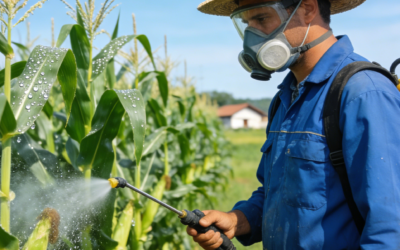
Spray equipment doesn’t lie. Set it up wrong, and even the best chlorantraniliprole application underperforms. The chemistry isn’t the problem. Here’s what that means in practice.
Ground Application: Spray Volume Is Everything
The label minimum for ground applications is 10 GPA. That’s your floor, not your target.
Auburn University’s precision ag research tracked canopy coverage at different spray volumes in peanut fields. The results were clear: 20 GPA beat 15 GPA beat 10 GPA — every time. More water reached the lower canopy. More of the product did its job.
So what’s the right call?
-
10 GPA — Label minimum. Meets compliance. Leaves coverage on the table.
-
15 GPA — The practical sweet spot. Solid canopy penetration without constant refills slowing down your day.
-
20 GPA — Best lower-canopy coverage. Takes longer. Worth it when foliage is thick or conditions are dry and hot.
Hot, dry weather and dense canopy both demand more water volume. Don’t lock into the same setup all season. Adjust as conditions change.
Nozzle Choice: The Numbers Are Telling
Most growers reach for standard XR/XRC flat-fan nozzles. They’re familiar. They’re common. They’re also losing you about 30% of finer particles before those particles reach the target.
Switch to TeeJet AIXR nozzles — coarse to very coarse droplets — and that loss drops to about 10%. That’s a real difference. At a 10 GPA target rate, an XR/XRC setup delivers around 7 GPA actual. An AIXR setup delivers closer to 9 GPA actual. You’re paying for 10. You should get 10.
Run pressure between 30–50 PSI for medium to coarse droplets. Stay away from TTI or dicamba-style ultra-coarse tips for chlorantraniliprole applications. The droplets are too large. They won’t reach deep enough into the canopy peanuts need covered.
Aerial Application
Aerial work has a different threshold: 2 GPA minimum for peanuts. Set your nozzle configuration and flight parameters to match that target. Coverage uniformity matters just as much from the air as it does from the ground.
Foliar Applications: Adjuvants and Split Timing
For foliar delivery, add a methylated seed oil adjuvant at 1% v/v — about 0.32 fl oz per 4 fl oz of Prevathon. This improves uptake and sticking.
Chlorantraniliprole works through ingestion of treated plant material. pest control depends on consistent, thorough coverage. The deeper into the canopy you get, the better your results. Thin coverage means thin control — simple as that.
Calibrate. Then Verify.
One final point that gets skipped too often: measure your actual output. Check multiple nozzles across the boom. Don’t assume the sprayer is delivering what the settings suggest. Worn tips, pressure fluctuations, and line inconsistencies are common problems. Find them before you hit the field, not after.
Recommended Rates and Products for Peanuts
The label is your contract. With chlorantraniliprole, that contract is specific. Follow it precisely — that’s what keeps your season clean instead of costly.
Prevathon (chlorantraniliprole 0.167 lb AI/gal) is the main foliar product for peanuts. The standard field rate is 17 fl oz/A per application. Most peanut programs run two applications at that rate. That covers the key window when caterpillar and thrips pressure hits hardest.
Coragen carries the same active ingredient at a higher concentration — 0.417 lb AI/gal. It fits programs that prefer lower-volume, higher-potency applications. It also works for soil incorporation at planting.
Foliar Rate by Pest and Pressure
Not every situation calls for the same rate. Here’s how the numbers break down in practice:
-
Tobacco budworm, corn earworm, fall armyworm: 17–20 fl oz/A of Prevathon per application
-
Beet armyworm and soybean looper: go to the higher end — 20 fl oz/A — these species are harder to knock down at minimum rates
-
Thrips suppression: 17 fl oz/A, timed at the start of canopy development
Stay within the season maximum of 34 fl oz/A for Prevathon. That’s two full-rate applications per season. Plan those applications with care. Use them only after pressure is confirmed and thresholds are crossed — not before.
At-Plant Soil Applications
Apply chlorantraniliprole in-furrow or as a banded soil treatment at planting. This protects against wireworms and other soil pests during the early establishment period, before the plant has time to harden off.
-
In-furrow (Coragen): 5–10 fl oz/A in a minimum of 3 GPA carrier volume
-
Banded soil application: 10–13.5 fl oz/A of Coragen, applied over the row at planting and incorporated by irrigation or rainfall
Soil applications and foliar applications count toward the same season maximum. Use Coragen at planting, and that amount comes out of your seasonal budget. Track it.
Seed Treatment Options
Seed treatment with chlorantraniliprole — sold as Lumivia — adds early-season protection before your foliar program starts. It’s worth considering in fields with a known wireworm history. It’s also a solid option where at-plant soil treatments aren’t practical to apply.
The pre-harvest interval for chlorantraniliprole in peanuts is 21 days. Mark your calendar from the last application. There’s no flexibility on this from a compliance standpoint. Skipping it creates legal and market risk you don’t need.
One Number That Matters
The full-season ceiling for chlorantraniliprole in peanuts — across all application methods, soil, seed, and foliar combined — is 0.4 lb AI/A. That’s the hard cap. At 17 fl oz/A of Prevathon (0.167 lb AI per application), two foliar sprays put you at 0.334 lb AI/A. Add an in-furrow Coragen application on top of that, and you’re right up against the ceiling. Know your running total before you spray.

Pre-Harvest Interval (PHI) and Re-Entry Interval (REI)
Two numbers on the label. Most growers glance at them and move on. That’s a mistake. These two numbers can get your crop rejected, make your workers sick, or put you in front of a compliance officer.
Know them cold before you spray.
PHI is the minimum days between your last application and harvest. Not a guideline. A legal floor. Harvest inside that window and you risk residues above the maximum residue limit (MRL). That means rejected loads, market access problems, and liability you don’t want.
REI is the minimum hours between application and any worker hand labor entry. That covers harvesting, scouting, thinning, and weeding. The REI is longer than the PHI? The REI wins. Full stop.
Chlorantraniliprole PHI and REI by Product
PHI and REI numbers differ across chlorantraniliprole formulations. That changes how you build your spray schedule:
-
Prevathon: PHI 14 days / REI 4 hours
-
Vantacor: PHI 1 day / REI 4 hours
The gap between Prevathon and Vantacor is big. Running a late-season application with a tight harvest window? Your product choice determines what’s actually possible. Vantacor’s 1-day PHI gives you far more flexibility than Prevathon’s 14-day requirement. Pick the wrong product and you may have to delay harvest or dump a load.
Tank Mixes Change the Math
Running chlorantraniliprole in a tank mix? Check every label in that tank. You use the longest PHI and the longest REI from all products combined. One partner product with a 24-hour REI overrides a 4-hour REI elsewhere in the mix. No averaging. No exceptions.
This catches growers off guard more than almost anything else. You can have three products with short REIs, but that one co-applicant with a longer interval sets the rule for the entire tank. Read every label before you mix.
Field-Level Compliance Habits
Simple systems stop violations before they happen:
-
Post visual markers — red flags mean just sprayed, green flags mean REI has cleared
-
Log every application — date, product, rate, and REI expiration in a notebook or calendar
-
Count backward from harvest — schedule your last Prevathon application no later than 14 days out
Growing for storage or processing? The PHI still gets assessed at the farm gate. The clock doesn’t reset once the product leaves your field.
Scouting and Timing Considerations

Applying chlorantraniliprole without solid scouting is like setting a trap after the animal has already left. You miss the window entirely.
The spray itself isn’t the problem. The decision behind it is.
Good scouting in peanut fields works in phases. Start broad, then narrow your focus. Don’t walk the field daily hoping to spot something. Build a clear observation system that shows you when pressure is rising — not just that it exists.
Build Your Sampling Routes First
Map your sampling routes before a single pest appears.
Walk set paths through each field. Record pressure by zone. Note where caterpillars show up first. Note where thrips tend to settle. After a season or two, those patterns repeat. That’s not luck — that’s data. Data is what separates reactive spraying from smart timing.
Once pests are confirmed, move to at least twice-weekly scouting. Pest populations in peanuts don’t build slowly. They spike fast. A field that looks clean on Monday can cross threshold by Thursday. Scouting twice a week keeps you ahead of that curve.
Match Your Timing to the Pest Window
Chlorantraniliprole’s two-application foliar program — 14 to 28 days after planting, then again 14 days later — isn’t random. That window lines up with canopy development, the phase when caterpillar and thrips pressure hits its peak.
Miss that window by even a few days and you’re either spraying an empty canopy or chasing an already-established population.
For thrips, run your first application at the start of canopy closure. Feeding damage builds fastest at that point. The plant is also most exposed to early-season setbacks that cut into final yield.
For caterpillar pressure — budworm, armyworm, soybean looper — hold off until scouting confirms populations have crossed your local action threshold. Spraying before threshold doesn’t speed up control. It burns one of your two seasonal applications and pushes selection pressure toward resistance.
Worth posting somewhere you’ll see it every day.
Your state cooperative extension service publishes action thresholds for your region. Use them. Those figures reflect local pest populations, local climate, and local yield economics. A threshold from the Southeast doesn’t apply cleanly to the Mid-South or Southwest.
At moderate pressure, 17 fl oz/A of Prevathon is the standard rate. Beet armyworm or soybean looper driving the problem? Move toward the 20 fl oz/A ceiling. These species perform poorly at minimum rates. Under-application costs you canopy, not just a few dollars per acre at the sprayer.
Scout with purpose. Time your applications with precision. Those two habits shape what chlorantraniliprole actually delivers in your fields.

Protecting your peanut crop doesn’t have to feel like guesswork. Chlorantraniliprole works best at the right rate, at the right time, and inside a solid IPM framework. Used that way, it becomes one of the most reliable tools in your pest management arsenal — not just a chemical, but a full strategy.
Ready to act on this? Start with your next scouting report. Identify your target pests. Confirm economic thresholds. Then build your chlorantraniliprole application plan around real data, not assumptions.
Winning growers don’t always have the biggest spray rigs. They’re the ones who know the right moment to apply — and the reason behind it.
That’s where good agronomy lives.

0 Comments