
Sugarcane and paddy crops feed billions of people. Yet a single pest outbreak can wipe out an entire season’s yield before a farmer spots any damage.
That’s why Imidacloprid has become one of the most trusted tools in modern crop protection. Growers use it to defend their fields against sucking pests, hoppers, and soil-dwelling threats — and it works.
But spraying and hoping isn’t enough. You need the right application method. You also need to understand resistance buildup and the environmental trade-offs involved. There’s real depth to this, and it’s worth knowing.
This guide covers it all — in plain language, no jargon.

Understanding Imidacloprid
Imidacloprid is not just another pesticide. It’s an engineered molecule built for one specific job.
Chemically, it carries the formula C₉H₁₀ClN₅O₂ (molecular weight: 255.66 g/mol, CAS No. 105827-78-9). In raw form, it looks like white to off-white crystalline powder with a faint, distinct odor. The melting point sits at 144°C. Vapor pressure is very low — 3 × 10⁻¹² mmHg at 20°C — so it does not volatilize much under field conditions.
How It Works
Imidacloprid belongs to the neonicotinoid class. Its structure draws from nicotine. It targets acetylcholine-gated cation channels in insect nerve cells. This disrupts normal signal transmission in the insect’s nervous system.
One structural detail makes a big difference: the =NNO₂ group. Swap it out for =NH, and the molecule starts binding mammalian receptors far more strongly. The original structure keeps binding selective to insects. That selectivity is the safety margin growers rely on.
The commercial product is mainly the (E)-isomer. This is the more stable and active form out of two possible geometric structures.
Role in Sugarcane Pest Management
Sugarcane loses between 15 and 35% of its yield to insects every season. That number isn’t an estimate — it’s the documented reality growers live with.
Imidacloprid sits at the center of modern sugarcane pest control. It solves one specific, stubborn problem: pests that feed underground, inside stalks, or through plant tissue before visible damage appears. By the time you see the symptoms, the economic damage is already done.
The Pests That Cost the Most
Three pressure points define sugarcane pest management:
-
Sugarcane borer (Diatraea saccharalis) — responsible for 90% of all insect crop losses in major growing regions. Every 0.75% increase in bored internodes erases 1% of sugar yield. That loss happens fast, and it adds up.
-
Greyback and Childers canegrubs — soil-dwelling larvae that destroy root systems with no warning. In Australian sugarcane, imidacloprid has been the main defense against these grubs since 2001. Growers apply it through sett dipping for consistent pre-planting coverage.
-
Spittlebugs (Mahanarva andigena) and aphids — sucking pests that pile more stress onto plants that are already under pressure.
What Integrated Management Looks Like in Practice
Louisiana’s sugarcane industry is the clearest proof that pest management, done right, is a long game. In the 1960s, growers applied 12 insecticide sprays per year. By 2017–2019, researchers monitored 388 billet samples across five mills. That spray count dropped to fewer than 0.3 applications per hectare per year. Bored internodes averaged just 1% at harvest — down from 5–28% in the 1950s. The result: $8 million saved per year in losses and control costs combined.
Soil-applied insecticides add another layer of protection. Fall planting applications cut cricket pressure by 50% and fire ant pressure by 30%. Skip that step, and bored internode rates climb to 17.8% — even with two extra mid-season sprays on top.
Imidacloprid’s systemic uptake — the way it moves through plant tissue to reach grubs and sucking insects — isn’t a bonus feature. It’s the core mechanism the entire strategy depends on.
Role in Paddy Pest Management
Insects destroy up to 37% of the rice crop every year. In major growing regions like Telangana, India — paddy covers 44 lakh acres and produces 7.34 million tonnes per year — field losses still run between 25 and 30%. Decades of pest control have not closed that gap. That’s where imidacloprid earns its place.
A Pest Calendar That Never Stops
Paddy fields don’t face one pest. They face a rotating cast of them, season after season.
Survey data from Tan Phu Thanh, Can Tho, Vietnam — tracked since 2000 — shows how that rotation plays out:
-
Winter-Spring season: Red stripe disease dominates. It records the highest area under insect-pest curve (AUIPC). Leaf folder severity rises through this period.
-
Spring-Summer season: Thrips emerge as the most serious pressure. Leaf folder stays as a baseline threat that doesn’t disappear.
-
Summer-Autumn season: Sheath blight and bacterial blight both peak here. Each records its highest AUIPC values across the full annual cycle.
Stepwise regression across 17 variables confirmed the five threats that drive yield loss the most: red stripe disease, weed infestation, sheath blight, narrow brown spot, and leaf folder. Those five determine what comes out of the field at harvest more than anything else.
How Pests Build Through the Kharif Season
Kharif 2020–21 field monitoring in Hyderabad, India, gives a clear picture of how pests build through a single growing cycle:
|
Pest |
Peak Period |
Peak Level |
|---|---|---|
|
Yellow stem borer |
4th week September |
6.6% dead hearts |
|
Leaf folder |
2nd week September |
6 larvae per 10 hills |
|
White ear (stem borer) |
3rd week October |
4.0% |
|
Brown planthopper |
1st week September onward |
Rising through grain fill |
|
Gundi bug |
Grain filling to milking |
Chaffy grain damage |
Yellow stem borer activity starts as early as the second week of July. Pressure reaches an actionable level by the third week of August. Miss that window, and dead heart percentages climb fast.
Monitoring That Works
Effective imidacloprid use in paddy depends on disciplined field monitoring — not calendar-based spraying. The standard protocol covers three critical stages: mid-tillering (25–30 DAS), panicle initiation, and early dough. At each stage, scouts check pest injuries, disease spread, weed pressure, and planting density together.
The threshold principle is simple. In fields using ecological engineering practices, all major pests can stay below the economic threshold level (ETL). This requires consistent 7-day monitoring from nursery through maturity — 10 random plants per observation point — with close attention to yellow stem borer dead hearts.
That monitoring structure makes targeted imidacloprid applications possible. Without it, growers spray on assumption rather than evidence. Resistance builds faster as a result.
Application Methods
Placement and timing are everything with imidacloprid. The molecule works — but it has to reach the target pest through the right delivery pathway. Four methods dominate field practice for sugarcane and paddy. Each one solves a different problem.
Sett Dipping (Sugarcane)
Seed setts go into an imidacloprid solution before planting starts. The cane pulls the active ingredient in through the cut surface. The emerging plant gets systemic protection from day one — before any grub or sucking pest can establish. Australian growers have used this approach since 2001, targeting Greyback and Childers canegrubs. Protection travels with the plant as it grows.
Soil Application (Sugarcane)
Granular or liquid imidacloprid placed at the furrow during planting reaches soil-dwelling pests that foliar sprays miss entirely. Louisiana research shows fall planting applications cut cricket pressure by 50% and fire ant pressure by 30%. Skip this step, and bored internode rates jump to 17.8% — extra mid-season sprays won’t fix that. Soil application isn’t optional. It’s a structural part of the program.
Seed Treatment (Paddy)
Coat or soak rice seeds in imidacloprid solution. They carry protection through germination and into the nursery stage. This matters most in the first few weeks. Yellow stem borer pressure starts building from the second week of July, and a treated seedling already has systemic defense loaded before it goes into the field. Application cost is low. The timing advantage is real.
Foliar and Soil Drench (Paddy)
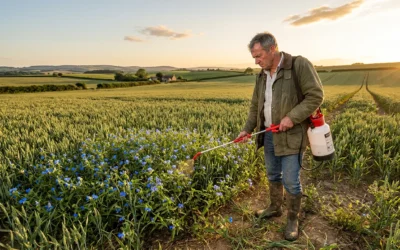
Use targeted foliar sprays to hit pest populations that cross economic thresholds during the growing season — brown planthopper, leaf folder, thrips. For stem borer pressure that needs a fast systemic response, soil drench applications push imidacloprid to the root zone fast.
One rule covers all four methods: application timing follows monitoring data, not the calendar. Spraying on assumption speeds up resistance. Spraying on evidence makes every application count.
Dosage and Timing
Getting the dose wrong costs you twice — once in wasted product, once in pest damage that comes back harder.
For sugarcane, the numbers depend on which grub you’re targeting:
-
Greyback Canegrub — 16–22 ml per 100 m of cane row (equals 1.05–1.44 L/ha)
-
Childers Canegrub — 11–16 ml per 100 m row (0.72–1.05 L/ha)
Both rates have threshold triggers built in. Go to the high end when grub counts pass 4 per stool for Greyback and 5 per stool for Childers.
Timing Windows for Sugarcane
Both canegrub applications fall in the September–November window. That’s no coincidence. This period lines up with beetle flight activity. Treating at this point cuts into the pest cycle — you’re stopping the problem, not cleaning up after it.
Start your application at the beginning of that window, as soon as flights pick up. Move to the higher rate as populations grow.
Granular formulations follow a separate set of numbers. The 2% GR product goes out at 100–200 kg/ha. The 0.1% GR product needs 4,000–5,000 kg/ha to hit an effective soil concentration. These two are not swappable. Check your formulation first, then calculate your volume.
Paddy Seed Treatment Rates
Seed treatment for paddy runs at 400–600 ml of imidacloprid per 100 kg of seeds. That range gives you room to adjust based on past pest pressure in your area. Fields with a heavy pressure history need the upper end of that range.
One Rule That Applies Everywhere
One application per crop or ratoon season. That’s the limit. Irrigation or rainfall within 24 hours of application activates the compound and pushes it down to the root zone. No moisture means uptake stalls — the product just sits there.
Going past that one-application limit does not add more protection. It builds resistance instead. Resistance is the one problem imidacloprid cannot fix.
Safety Precautions and Environmental Impact

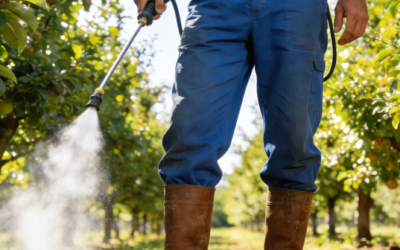
Imidacloprid works because it’s toxic. That toxicity doesn’t switch off the moment it leaves the sprayer.
Handling this compound without knowing its risks isn’t just careless. It puts you at real risk of harm — and so does the ecosystem around you.
The Environmental Side Is Complicated
Imidacloprid stays active in soil for a long time. That’s part of what makes it work. It’s also what makes caution non-negotiable.
The compound binds to soil particles and breaks down at a slow rate under normal field conditions. That slow release keeps protection active. It also means residues can build up with repeated use — more so in heavy clay soils with low microbial activity.
Water contamination is the bigger concern. Heavy rain runoff can carry imidacloprid into drainage systems, irrigation channels, and nearby water bodies. Aquatic invertebrates are at high risk. Pollinators — bees above all — face a real exposure risk once treated plants flower and produce pollen or nectar carrying trace residues.
Efficacy and Resistance Management

Resistance doesn’t announce itself. It builds slowly — one application at a time — until the chemistry that worked last season stops working.
imidacloprid delivers measurable results with correct application. Synthetic insecticides as a class reduce target pest populations by 75% compared to untreated control groups. That’s a significant margin. But that number drops every time resistance pressure goes unmanaged.
The Real Cost of Ignoring Resistance
The economics are clear. US farmers lose an estimated $1.5 billion per year to pesticide resistance across all crop types. For individual growers, resistance-affected fields return less per acre, cost more to manage, and produce lower yields — season after season.
Year one of a resistance management program can feel like a step backward. Returns dip a little as you rotate chemistries and pull back on repeat applications. By year two, cumulative gains outpace the cost of ignoring the problem. The math catches up either way — the question is whether it catches up in your favor.
What a Rotation Strategy Looks Like in Practice
Preset rotation programs outperform reactive chemistry switching. Switching insecticides after you’ve detected a population shift is too late. Resistance reaches detectable levels at 1% or lower in a population — by that point, the window to slow its spread has already closed.
For imidacloprid, the working framework is:
-
One application per season — the hard limit that protects both efficacy and environmental load
-
Rotate with non-neonicotinoid modes of action between seasons to reduce selection pressure
-
Use monitoring data to choose which insecticides rotate, not just the timing of each application
-
Integrate biological controls — tools like Trichogramma act as complementary inputs that spread pressure across pest populations without adding chemical load
Resistance management isn’t a yield strategy. It’s a durability strategy. Fields still producing strong returns in year five are the ones where this discipline started in year one.
Future Perspectives

The tools growers use today won’t look the same in a few years. Most field guides don’t talk about this enough — but it’s a big deal.
Precision agriculture is already changing how imidacloprid gets used. Smart sensing networks — IoT devices paired with edge AI — are pulling crop protection away from fixed calendar schedules. Real-time, data-driven decisions are taking over. Soil moisture sensors and pest population models now share data with each other. Application timing gets sharper. Waste drops. Resistance pressure slows down.
The next step is full integration. Multi-agent coordination systems will one day pull in weather data, pest monitoring, and soil residue levels all at once. They’ll flag the right moment and location for an imidacloprid application. They’ll also flag when rotating to a different mode of action makes more sense for long-term resistance control.
For resistance management, that level of precision isn’t optional — it’s essential. There are two paths ahead:
-
Imidacloprid stays a reliable tool in 2035 because growers used it with precision
-
Or it becomes another chemistry that growers lost confidence in — and set aside
The difference comes down to whether the data gets used or ignored.

Protecting your sugarcane and paddy crops isn’t guesswork — it’s a science. Imidacloprid gives you a proven tool to do it well.
Apply it at the right time and it controls the pests that damage your yield most. Target infestations in their early stages. Stick to recommended dosages. Rotate with other chemistries to stop resistance from building. These aren’t optional steps — they’re what separates a thriving crop from one that struggles to make it through the season.
Now it’s your move. Pull up your pest management calendar. Find the gaps. See where imidacloprid fits into a smarter, more integrated approach.
The farmers who outperform don’t just react to pest pressure — they anticipate it.

0 Comments