
Managing orchard pests? You need the right insecticide and the right application. Both matter.
Imidacloprid works well for fruit growers fighting aphids, scale insects, and other tough pests. But here’s the catch: your application method makes all the difference.
You can drench the soil around your trees. You can spray the foliage with care. Or you might try a chemigation setup. Each method has its own benefits and quirks.
Timing matters. So does knowing your equipment. Avoid mixing mistakes too. These details separate thriving orchards from struggling ones.
We’re covering practical, tested methods that make imidacloprid work better for your trees. No guesswork needed.

Soil Application Methods
Pour imidacloprid into the soil around your fruit trees. This creates a protective shield from the roots up. The chemical moves through the tree’s system. It reaches leaves, stems, and fruits where pests feed. This approach protects for months, not just days.
Soil drenching works best during active growing seasons. Apply in spring—right when buds break. Trees get maximum uptake time. Fall treatments work too in warmer climates. Roots stay active longer there. Skip winter application. Trees are dormant and won’t absorb the chemical well.
Measuring Your Drench Volume
Calculate the amount based on your tree’s diameter at breast height (DBH). Standard recommendation: 1 gallon of diluted solution per inch of trunk diameter. A 10-inch trunk needs 10 gallons. You get good coverage without waste.
Mix imidacloprid according to label rates. Most products call for 0.4 to 0.8 fluid ounces per gallon of water. Read your specific product label. Concentrations vary between brands. Use clean water. High pH or mineral content can cut effectiveness by 15-20% according to field trials.
Application Zone Precision
Pour the solution in a circle around the trunk. Don’t pour against the bark. Start 12 inches out from the trunk. Extend to the drip line—where the canopy edge sits. This targets the feeder root zone. Uptake happens fastest there.
Young trees (1-3 years old) need special care. Their root systems are smaller. They’re more sensitive too. Cut concentration by half. Apply closer to the trunk—about 6-8 inches out. Monitor soil moisture. Dry soil blocks absorption. Saturated soil causes runoff.
Soil Type Considerations
Clay soils hold imidacloprid longer. But they release it slower. Sandy soils work opposite—quick uptake but faster breakdown. In heavy clay, wait 3-5 days between application and irrigation. This allows initial absorption. Sandy orchards can be watered within 24 hours.
Check soil pH before treatment. Imidacloprid binds hard in alkaline soils (pH above 7.5). This cuts bioavailability. Acidic conditions (pH 5.5-6.5) boost mobility. Does your pH run high? Consider acidifying amendments. Or choose foliar application instead.
Equipment Essentials
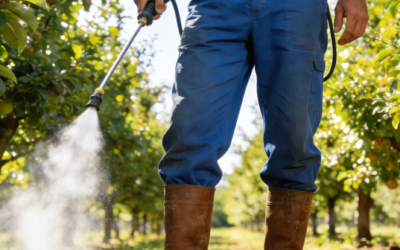
Backpack sprayers work for small orchards (under 50 trees). Motorized drench rigs handle larger operations better. Whatever you use, calibrate first. Pour a measured gallon into your equipment. Mark the container. This becomes your visual guide during application.
Protect yourself. Chemical-resistant gloves, long sleeves, and eye protection aren’t optional. Imidacloprid absorbs through skin contact. Wash hands right after finishing. Do this even if you wore gloves the entire time.
Record each application date, rate, and tree location. This tracking stops accidental double-dosing. It helps identify which trees got treatment if pest pressure continues.
Airblast sprayers shoot pesticide at high speed through orchard rows. The tech wastes more than it delivers. Old systems put 30% of spray solution on target. The rest? Between 45-70% hits the ground or drifts away.
That’s money falling into dirt.
Variable-rate tech changes this. USDA Agricultural Research Service tested these systems across orchards. Results: 50% less spray volume needed. Airborne drift dropped 50-74%. Missed spray fell 34-74%. Labor and fuel costs cut by 32%. Growers saved $406-504 per acre each year. These aren’t small wins—they’re game-changers.

Match Your Volume to Canopy Density
Your trees change through the season. Your gallons per acre (GPA) should too.
Full bloom brings 49% canopy density. Use 21.6 GPA with variable-rate systems. At fruit drop, density jumps to 75%—bump up to 24.5 GPA. During ripening (69% density), you’ll need 25.1 GPA. This precision keeps you from overdosing sparse areas. It also prevents under-treating thick spots.
Tree height matters too. Shorter orchards under 10 feet work well with 70-100 GPA. Standard advice ranges 30-150 GPA total. But don’t follow old habits without thinking. Too much spray creates 4-15 times more droplets than needed on leaves. That’s runoff waiting to happen.
Nozzle Configuration Math
Setting up nozzles isn’t guesswork. Here’s a tested example for 75 GPA on one sprayer side:
Top half of canopy (75% of total output): 6.73 GPM total. Try six D4-45 nozzles at 0.68 GPM each, plus one D5-45 at 0.86 GPM.
Bottom half (25% of output): 2.22 GPM total. One D5-45 plus two D4-45 nozzles.
This setup matches how most fruit trees grow. Denser leaves up top. Sparser below.
Speed and Wind Windows
Drive 1.5-2.0 MPH through rows. This sweet spot gives coverage without waste. Double your speed and you’ll cut GPA in half—rarely what you want. Some operators crawl at 1 MPH for max coverage in thick canopies. Others push to 3 MPH on young blocks.
Never spray past 5 MPH wind. Period. Field trials compared different sprayer types. DAT and MFT sprayers put down 4-15% less spray at mid-range. They also dropped 35-37% less at far distances compared to air-assisted fan sprayers.
Stop Wasting What Goes Up
Install two deflectors on top of your fan—one per side. These block the spray pattern that sends pesticide straight up into empty air. No canopy overhead? No spray needed there. This simple add-on cuts drift and chemical waste fast.
Turn off nozzles pointing up if no tree overhang exists above them. Direct all spray into leaves using deflectors and aiming tools. Your air needs to reach through the canopy. But that doesn’t mean spraying in all directions without aim.
At row ends, shut the sprayer off. Don’t send chemicals beyond your growing area. On exterior rows, spray inward toward the orchard center.
Here’s an eye-opener: exterior rows see 5% off-target spray. Interior rows? 25%. Variable-rate tech cuts this waste to three times less. Your neighbors—and your budget—will thank you.

Getting imidacloprid application right in your orchard means more than reading the label. You need to know your trees, your timing, and your tools. Soil drenching around young saplings? Misting leaves at dawn? Running a precision chemigation system? Each method works best in specific situations. Proper dilution ratios matter. Calibrated equipment matters. Knowing when not to spray matters. These small details separate weak pest control from full-season protection.
Here’s the thing: imidacloprid works great with the right approach. Pick the method that fits your orchard’s size and pest pressure. Always double-check your mixing calculations. Keep detailed records of what you use and when. Your future self will thank you. Your trees will thank you.
Want to put these techniques into practice? Walk your orchard this week. Check which application method fits your current needs. The best investment isn’t always a new sprayer. Sometimes it’s mastering the one you already have.

0 Comments