
Garden pests destroying your plants? Imidacloprid might be your answer. This systemic insecticide ranks among the most powerful options available today.
This neonicotinoid compound delivers knockout punches to stubborn garden invaders. But which pests does it target?
Imidacloprid controls specific insects. Knowing which ones helps you manage pests better while using chemicals the right way. Sap-sucking aphids curl your rose leaves. Grain-destroying rice beetles damage crops. This insecticide targets a specific group of pests.
We’ll cover the top five insects that imidacloprid kills. You’ll learn why it works so well against them. Plus, you’ll find out if this is the right solution for your pest problem.
Aphids
These soft-bodied insects drain life from your plants one drop at a time. Imidacloprid targets aphids with precision. Gardeners and commercial growers rely on it.
Aphids breed fast. A single female can produce up to 80 offspring in just one week without mating. They cluster on tender shoots, leaf undersides, and buds. Their feeding causes leaves to curl and yellow. The leaves then drop. They also secrete honeydew—a sticky substance that attracts ants and promotes black sooty mold growth.
Why Imidacloprid Works Against Aphids
Imidacloprid works through systemic action. Plants absorb the chemical through roots or leaves. It travels through the vascular system to all plant parts. Aphids pierce plant tissue to feed. They ingest the insecticide. Their nervous systems shut down within hours.
Research shows aphid numbers match host plant availability. Studies document that host plant abundance alone explains aphid populations best (intercept 5.917 ± 0.364, coefficient 1.504 ± 0.284, p=1.16E-07). More host plants equal more aphids. Targeted treatment is crucial.
Population Dynamics and Treatment Timing
Both winged (alate) and wingless (apterous) adult aphids contribute to infestations. Scientists measure abundance by counting both forms together. Key factors drive population explosions: cumulative degree days, precipitation levels, and Julian day timing all influence aphid numbers.
Crop diversity plays a protective role. Higher Shannon Diversity Index values in agricultural landscapes reduce aphid species richness within a 3-kilometer buffer zone. This 2021 field season data suggests diverse plantings suppress aphid variety.
Urban settings face unique challenges. Aphid species numbers match human population density—even after controlling for country area and latitude. City gardens harbor more aphid species than rural areas.
Imidacloprid soil drenches provide season-long protection. Foliar sprays deliver faster knockdown for active infestations. The chemical stays effective for 8-12 weeks as a soil treatment. This makes it ideal for ornamentals, vegetables, and fruit trees suffering from persistent aphid pressure.

Whiteflies
Whiteflies look like tiny moths but cause damage more like aphids. Imidacloprid kills these persistent sap-feeders on many plant types. Adults measure just 0.8-2 mm (0.03-0.08 inch) long. This small size makes them hard to spot until their numbers explode.
These pests breed fast through six growth stages. Females lay oval eggs measuring 0.2 mm (1/100 inch) long. The eggs start pale green, yellow, or white. They turn grayish, brown, or black as they grow. Several generations hatch each year. This keeps infestation pressure constant through growing seasons.
Species That Attack Your Plants
Greenhouse whitefly (Trialeurodes vaporariorum) stands out with opaque white pupae. The pupae show raised vertical sides and long waxy threads on top. Adults appear larger and whiter than other species. They hold wings flat over their abdomens in a triangular shape. Females place eggs on upper plant surfaces. The eggs turn brown-black as they mature. You’ll find this species on greenhouse crops, ash, dogwood, sycamore, sweetgum, honey locust, black locust, and redbud.
Banded-winged whitefly shows unique markings. Pupae have oval shapes with raised vertical sides. A light brown center area runs through the middle. Dense wax fringes appear in two different lengths along the edges. Long hooked threads extend from the top. Adults show darker head and thorax markings. They rest with roof-like wings showing 2-3 grayish-brown zigzag lines. This species targets hibiscus, petunia, geranium, and poinsettia.
Ficus whitefly attacks specific plants. Adults reach 1/16 inch with grayish-brown wing markings. Females lay pale brown-yellow eggs along main leaf veins on undersides. Nymphs appear pale green-tan, flat, oval, and semi-transparent. This species mainly infests Ficus microcarpa.
Citrus blackfly threatens southern crops. Adults measure 1.3-1.6 mm long. Slate-blue wings contrast with bright red abdomens. Eggs range from pale yellow to pink, arranged in spiral patterns. Pupae show oval shapes with raised vertical sides and wax fringes. South Texas citrus groves face high risk from this species.
How Imidacloprid Delivers Control
Imidacloprid travels through plant tissues after you apply it. Whiteflies pierce leaves to extract phloem sap. They consume the insecticide with every feeding. The compound disrupts their nervous system. Both nymphs and adults die from treatment. Soil drenches protect plants for 8-12 weeks. Foliar applications give faster knockdown on ornamentals and greenhouse crops with large populations.

Thrips
Thrips are among the most harmful pests in farming. Their tiny size hides their true threat. These thin insects measure under 3 mm long. Scientists have found about 6,300 species worldwide. North America has around 1,000 species. Despite their small size, they destroy commercial crops and home gardens.
Imidacloprid controls many thrips species well. This compound works through the plant’s system. Plants take it in through roots or leaves. Thrips scrape plant tissue and suck out cell contents. They eat the insecticide while feeding. Their nervous systems shut down within 24-48 hours.
Major Thrips Families and Pest Species
The thrips world splits into two groups: Terebrantia covers most families. Tubulifera has just Phlaeothripidae. Five main families live in North America. Eight exist around the world.
Thripidae is the biggest pest group. This family has over 2,000 species across 290 genera. The genus Thrips has more than 280 species. Thrips tabaci (onion thrips) causes serious farm damage. It spreads tospoviruses between plants. Frankliniella occidentalis (western flower thrips) attacks vegetables, ornamental plants, and greenhouse crops. Frankliniella tritici (flower thrips) and Sericothrips variabilis (soybean thrips) destroy field crops. Thrips simplex hits gladiolus, lilies, irises, and freesias. Thrips angusticeps harms flax, grain, and pea crops.
Phlaeothripidae is the largest thrips group. Phlaeothripinae has 375 genera and 2,820 species. Leptothrips mali harms fruit trees. Many species in this tube-tailed group act as both pests and helpful predators.
Aeolothripidae has 29 genera of predatory thrips. Franklinothrips vespiformis eats pest thrips. You can’t tell it apart from F. orizabensis in the field. These helpful species control pest numbers.
Application Strategy
Soil drenches protect plants for long periods. Foliar sprays stop active infestations faster. Thrips tabaci shows up often in US port inspections. Treat them right away to stop population booms. Imidacloprid works well across many thrips species in vegetables, ornamental plants, and field crops.

Leafhoppers
Leafhoppers are one of the most varied insect groups in farming. The Cicadellidae group has 983 species across the United States. This count comes from iNaturalist submissions. Florida alone has 158 species. These sap-feeding bugs are part of order Hemiptera, suborder Auchenorrhyncha, group Cicadomorpha. Imidacloprid works well against them. The chemical moves through plant systems and attacks their nerves.
You’ll see spotted lanternflies, red-banded leafhoppers (Graphocephala coccinea), versute sharpshooters, and glassy-winged sharpshooters most often. Farm crops face threats from potato leafhopper (Empoasca fabae), maple leafhopper (Alebra albostriella), rose leafhopper (Edwardsiana rosae), and white-banded elm leafhopper (Scaphoideus luteolus). Each type feeds on specific plants. They keep feeding and cause damage.
Telling Leafhoppers Apart from Similar Bugs
Three bug types look alike. This confuses growers. Treehoppers have large pronotums. These are thorax spines or bumps that cover their bellies. They also care for their young. Planthoppers come from the Fulgoromorpha group. The US has 429 species. Florida has 132 species. They don’t have thorax bumps. Spittlebugs make foam masses on plants. Leafhoppers don’t have any of these traits.
Scientists tell leafhopper types apart by checking male parts. Remove the belly section. Soak it in 10% potassium hydroxide for a few hours. Or boil it for a few minutes. Rinse it in water with a bit of glacial acetic acid. Rinse again in clean water. Put it in glycerine to view it.
Finding Them and Using Imidacloprid
Check the end leaves first in spring. This is best right as leaves open. Look for rough, whitish spots near the middle vein. Put out yellow sticky traps to watch population numbers. Leafhoppers walk and jump sideways fast. They do this during the day if you disturb them. At night, they go to lights. Light traps work great for tracking them after dark.
Imidacloprid soil treatments move through plant veins. This takes 7-10 days. Leafhoppers poke into plant tissue. They drink the treated sap. The chemical stops their nerve signals. Each treatment protects for 8-12 weeks. Sprays on leaves give faster results. Use these on vegetables, ornamentals, and fruit trees during big population spikes.

Rice Beetles
Imidacloprid protects rice crops from beetles. These beetles attack growing plants and stored grain. Beetle damage is serious—2020 data shows 3.85% yield loss across Arkansas, California, Florida, Louisiana, Mississippi, and Texas. These six states grow 90% of US rice. Total costs and losses topped $340 million. That’s $120 per acre on average.
Rice water weevil (Lissorhoptrus oryzophilus) causes the most yield loss. Adult beetles and larvae attack rice roots at key growth stages. Larval feeding cuts roots. This drops yields by 29%—about 500 pounds per acre. The data comes from 1930s research that still applies today. Heavy infestations cause up to 70% yield loss. California growers see typical losses of 45% with flood irrigation. Texas farmers lose 500-1,000 pounds per acre to this pest alone.
Rice stink bug (Oebalus pugnax) ranks second for crop damage. Uncontrolled populations cause 5-10% yield loss. These bugs pierce rice kernels during the milk stage. Their feeding creates “pecky rice”—shriveled and discolored kernels. This drops grain quality. The history shows the damage: 1930s attacks in Louisiana, Texas, and Arkansas downgraded 50% of rice crops. Annual losses hit $473,000 (2% of total crop value). Texas recorded losses of $5.91-$29.34 per acre from 1981-1984. These bugs now infest nearly all rice fields in Arkansas, Louisiana, and Texas.
Economic Impact and Treatment Returns
Growers use foliar insecticides at 0.69 applications per acre on average. This costs $8.83 per acre. Application rates differ greatly—California uses just 0.01 per acre. Florida uses 1.25 per acre. Rice stink bug gets the most insecticide treatments.
Treatment pays off. Imidacloprid and other stink bug controls returned $0.27 per hundredweight gain in 1970s Texas trials. Arkansas research from the 1980s showed $49 per acre net profit through 3% peck reduction. Water weevil treatments boost yields by 800-1,000 pounds per acre (a 20% gain). Net returns top $40 per acre. Today, one-third of US rice acres get treated with lambda-cyhalothrin, zeta-cypermethrin, or imidacloprid.
Application Strategy for Rice Beetles
Tenchu 20SG (with imidacloprid) mixed with pyrethroids cuts peck levels below 0.9% in farm trials. Scientists have tested about 8,000 rice lines for weevil resistance. None show strong resistance. Chemical control is necessary.
Lesser grain borer (Rhyzopertha dominica) attacks rice after harvest. This beetle harms both grain quantity and quality in storage. Imidacloprid protects stored grain from these beetles. The compound stays active. This stops post-harvest losses that would cut marketable grain.

Mechanism of Action
Imidacloprid disrupts insect nervous systems at the molecular level. This insecticide binds to specific receptors (nAChRs) in insect nerve cells. These receptors receive chemical signals that control muscle movement and vital functions. Imidacloprid attaches to these receptors. This blocks nerve signal transmission.
The compound acts as an agonist. It mimics acetylcholine’s action but stays attached to the receptor. This creates constant nerve stimulation. Insect muscles contract without control. Paralysis happens within hours. The insect stops feeding. Death occurs within 24-72 hours based on dosage and species type.
Why It Targets Insects, Not Mammals
Insect receptors differ in structure from mammalian ones. Imidacloprid shows 10,000 times higher attraction for insect receptors than vertebrate receptors. This selective binding explains its low toxicity to humans and pets. The compound binds tightly to insect nerve cells. It has minimal effect on mammalian nervous systems at typical application rates.
Systemic Distribution Through Plants
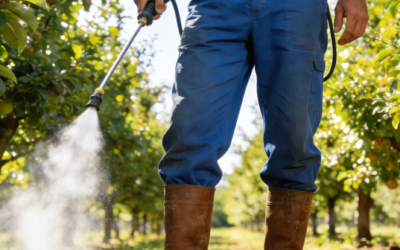
Plants absorb imidacloprid through two pathways. Root uptake occurs with soil drenches. The chemical dissolves in soil water. Roots absorb it with nutrients. Foliar absorption happens with spray applications. Leaf surfaces take in the compound through stomata and outer layers.
Once inside, the insecticide moves through xylem vessels—the plant’s water transport system. It travels upward from roots to stems, leaves, flowers, and fruits. This systemic movement protects all plant parts. New growth after application gets protection too. The compound stays in plant tissues for 8-12 weeks. Insects feeding on treated plants ingest lethal doses.
Soil applications provide longer-lasting control than foliar sprays. The chemical releases from soil particles into root zones over time. This creates lasting protection against sap-feeding pests like aphids, whiteflies, and leafhoppers that pierce plant tissues multiple times.
Imidacloprid works on many different pests. It controls sap-feeding aphids, whiteflies, and rice beetles that damage crops. This insecticide targets the insect nervous system. It’s safer for mammals. Farmers and home gardeners use it in pest management programs.
Know which pests respond to imidacloprid. This helps you protect your crops better. Got thrips in your greenhouse? Dealing with leafhoppers in your orchard? This product provides protection that reaches hidden pests. Regular sprays often miss these pests.
Ready to control pests effectively? Follow label instructions. Rotate chemical classes to stop resistance. Combine imidacloprid with other control methods for better results. Apply it at the right time. This can save your crop and boost your harvest.


0 Comments